Navi Mumbai or Thane: which should you buy in?

Buyers priced out of Mumbai usually end up comparing Navi Mumbai with Thane, and the two are genuinely close on price while being quite different in character. The decision almost always resolves on one variable, and it is not the one most buyers start with.

The variable that actually decides it

Where you work decides this comparison more than anything else, and the two cities serve opposite ends of the Mumbai map.

Thane sits on the central line and the Eastern Express Highway, which makes it strong for Powai, Vikhroli, Ghatkopar, BKC via the highway, and anywhere on the central corridor. It is also the natural choice for the Thane-Kalyan employment belt.

Navi Mumbai sits on the harbour line, which serves Chembur, Kurla, Wadala and south Mumbai. It is also the only option for the airport corridor, the Kharghar corporate belt and JNPT.

If your workplace is fixed, this usually settles the question before price enters the conversation. Buyers who ignore it and optimise for price first tend to relitigate the decision within two years.

  • Thane: central line, Eastern Express Highway, Powai and BKC access
  • Navi Mumbai: harbour line, south Mumbai, airport and Kharghar corridors
  • Fix the workplace before comparing anything else

Where Thane is stronger

Thane is closer to Mumbai in both distance and feel. It has a longer history as a city in its own right, denser retail, and a lake-and-hill setting that many buyers prefer to Navi Mumbai's planned flatness.

It also has a deeper premium segment. The Ghodbunder Road corridor and the belt around the lakes carry large integrated townships at a scale Navi Mumbai matches only in Kharghar and Panvel.

Commercial depth is the third advantage. Thane has more established office stock and a broader local employment base than most Navi Mumbai nodes, which supports rental demand independent of Mumbai commuters.

For buyers working anywhere on the central corridor, Thane is usually the better answer, and no amount of Navi Mumbai infrastructure changes that.

Where Navi Mumbai is stronger

Planning is the clearest advantage. The CIDCO sector grid produced wide roads, generous plot ratios and consistent civic layout across most nodes, which Thane, having grown organically, cannot match outside its planned townships.

Infrastructure trajectory is the second. The airport, the Atal Setu and Metro Line 1 are all operational rather than proposed, and they are concentrated here. Our note on the Mumbai Trans Harbour Link covers what that changed.

Space per rupee is the third, particularly in the Taloja, Panvel and Upper Kharghar belt, where budgets stretch considerably further than in comparable Thane locations.

Air and density are the fourth. Navi Mumbai's lower-density planning produces a materially different daily experience from Thane's busier corridors, which matters more to some households than any commute calculation.

  • Consistent CIDCO planning across most nodes
  • Operational airport, Atal Setu and Metro Line 1
  • More space per rupee in the southern belt
  • Lower density and a different daily feel

On price, they are closer than people assume

The instinct that Navi Mumbai is cheaper than Thane holds only in parts. The Palm Beach corridor nodes price comparably with good Thane locations, and Kharghar competes directly with the Ghodbunder belt.

Where Navi Mumbai is genuinely cheaper is the southern and eastern belt: Taloja, Panvel periphery, Kalamboli and Upper Kharghar. Those have no real Thane equivalent at the same distance from Mumbai.

Comparing node to node rather than city to city is therefore essential. A Thane-versus-Navi-Mumbai price comparison at city level tells you almost nothing, because both cities span a very wide range.

The long-term case for each

Navi Mumbai's long-term case rests on infrastructure that already exists and employment that is still arriving. The airport, port and corporate belts create a growth story that does not depend on Mumbai's own trajectory, which is genuinely unusual in this market.

Thane's long-term case rests on proximity and established demand. It is closer, more integrated with Mumbai's economy, and its property market behaves more like an extension of the city than an alternative to it.

The risk profiles differ accordingly. Navi Mumbai carries delivery risk on the employment that is meant to follow the infrastructure. Thane carries less upside but also less of that specific risk.

For a long-horizon buyer, Navi Mumbai's southern belt probably has more headroom. For a buyer wanting a settled market with predictable behaviour, Thane is the safer expression of the same budget.

Who should choose which

Choose Thane if you work on the central corridor, Powai or BKC via the highway, if you want a denser city feel with established retail, or if you value a settled market over a growth story.

Choose Navi Mumbai if you work in south Mumbai, the airport corridor, Kharghar or the port belt, if you want more space per rupee, or if consistent planning and lower density matter to your daily life.

Choose either, honestly, if your work is remote or flexible. In that case the decision comes down to which city you would rather live in, and both have genuine advocates for good reasons.

  • Thane: central corridor work, denser city feel, settled market
  • Navi Mumbai: south Mumbai or airport work, space, planning, lower density
  • Remote workers: decide on lifestyle rather than commute

How to test it properly

Run both commutes on a working day, in both directions. This costs two days and resolves the majority of these decisions definitively, which is a better return than any amount of comparison reading.

Then compare at the level of specific flats rather than cities. Take your budget to two nodes in each and compare carpet area, building age, possession and commute side by side.

For the Navi Mumbai side, verified inventory is the fastest way to see what a budget genuinely reaches: flats under 1 crore in Navi Mumbai and 2 BHK flats in Navi Mumbai between 1 and 2 crore cover the two most common bands.


EditRelated Properties

Projects worth exploring.

If this theme fits your search, start here.

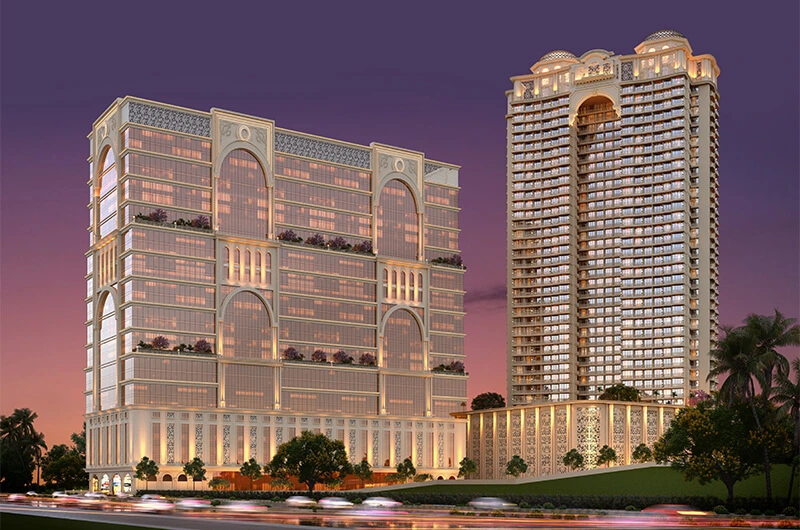
Office Spaces & Retail Shops in Nerul Navi Mumbai - 24 High
Under ConstructionNerul

Dream Apex Realities Limited

24 High

Commercial office spaces and retail units opposite DY Patil Stadium in Nerul. Carpet 430 - 820 sq.ft. Possession Apr 2026.

  • Office Spaces & Retail Shops
  • Rs. 92 L - 1.74 Cr
  • MahaRERA: P51700025150
View details
Premium Offices & High-Street Retail in Nerul Navi Mumbai - Kamdhenu Zeus
New LaunchNerul

Kamdhenu Builders & Developers

Kamdhenu Zeus

Launch-stage commercial tower with premium offices and retail in Shiravane, Nerul. Carpet 484 - 1587 sq.ft. Possession Dec 2030.

  • Premium Offices & High-Street Retail
  • Rs. 1.25 Cr - 2.38 Cr
  • MahaRERA: PC1330002500481
View details
2 & 3 BHK flats in Nerul Navi Mumbai - Sai World One
New LaunchNerul

Paradise Group

Sai World One

2 & 3 BHK homes in Nerul. Carpet 860 - 1290 sq.ft. Possession Dec 2029.

  • 2 & 3 BHK
  • Rs. 1.80 Cr - 2.70 Cr
  • MahaRERA: Awaited
View details
1 & 2 BHK flats in Panvel Navi Mumbai - Today Saubhagyam
Under ConstructionPanvel

Today Group

Today Saubhagyam

1 & 2 BHK homes in Panvel. Carpet 436 - 580 sq.ft. Possession Dec 2028.

  • 1 & 2 BHK
  • Rs. 46 L - 69 L
  • MahaRERA: P52000053782
View details
2, 3 & 4 BHK flats in Kharghar Navi Mumbai - Kasturi Regius Luxe
Under ConstructionKharghar

Kasturi Developers

Kasturi Regius Luxe

2, 3 & 4 BHK homes in Kharghar. Carpet 812 - 1945 sq.ft. Possession Dec 2027.

  • 2, 3 & 4 BHK
  • Rs. 1.62 Cr - 3.88
  • MahaRERA: P52000079465
View details
2 & 3 BHK flats in Kharghar Navi Mumbai - Bhagwati Avenoir
New LaunchKharghar

Bhagwati Developers

Bhagwati Avenoir

2 & 3 BHK homes in Kharghar. Carpet 804 - 1152 sq.ft. Possession Dec 2028.

  • 2 & 3 BHK
  • Rs. 1.65 Cr - 2 Cr
  • MahaRERA: Awaited
View details
EditRelated Localities

Related localities.

Use these pages to compare the surrounding micro-markets.

Kharghar

Property in Kharghar

Premium residential node with metro access, green lifestyle, and strong social infrastructure - Navi Mumbai's most mature mid-premium market

PositioningPremium node
Buyer intentFamilies + upgraders
Buying lensLifestyle + stability
  • Kharghar's appeal is layered. At the foundation is its extraordinary physical infrastructure - wide CIDCO roads, reliable water supply, sector-wise power distribution, and a civic environment that feels planned rather than improvised. On top of that sits a rich social infrastructure: reputed schools including DPS Navi Mumbai and Ryan International, hospitals, the massive 85-acre Central Park (one of Asia's largest urban parks), an 18-hole golf course, and well-developed commercial zones.
  • Metro Line 1, operational since November 2023, now connects Kharghar directly to CBD Belapur and Pendhar, with future extensions planned toward Khandeshwar and ultimately the Navi Mumbai International Airport. Properties within a kilometre of Kharghar's metro stations have seen an estimated 15-20% appreciation premium since the metro's launch.
  • The Navi Mumbai International Airport, approximately 14 km from Kharghar, commenced commercial operations in December 2025 - adding a structural appreciation catalyst to a node that already had strong fundamentals.
Explore Kharghar
Nerul

Property in Nerul

Mature, premium Navi Mumbai node - established social infrastructure, strong rail connectivity, aspirational address

PositioningEstablished premium
Buyer intentPremium end-use
Buying lensMature living
  • Nerul's appeal centres on its completeness as a neighbourhood. Every category of social infrastructure - from schools like DAV Public School and Apeejay School, to hospitals, to well-stocked commercial markets and malls - is available and functioning at a mature level. Residents do not need to travel to other nodes for daily needs. That convenience, rare in even the best planned cities, commands a consistent premium in Nerul's property market.
  • New project launches in Nerul are genuinely rare, which means that when quality projects do come to market here, they attract strong demand from informed buyers. Today Nova Vista is one such project - a premium development in a locality where scarcity of new inventory is itself a pricing support.
Explore Nerul
Panvel

Property in Panvel

Navi Mumbai's fastest-appreciating node, supercharged by the Navi Mumbai International Airport and MTHL - the city's most compelling investment destination

PositioningAirport-led growth
Buyer intentInvestor + commuter
Buying lensHigh appreciation
  • Panvel offers a rare combination: the growth momentum of an emerging market with the connectivity of an established one. The Panvel Railway Junction connects to CSMT via the Harbour Line and to Pune via the Deccan Express corridor. The Mumbai-Pune Expressway starts near Panvel. The Atal Setu (MTHL) puts South Mumbai 20-45 minutes away by car. And the Panvel-Karjat Rail Corridor, approximately 67% complete as of early 2026, will slash commute times further when operational.
  • For investors, new project launches in Panvel have been moving faster than pre-2020 levels according to local market observers. Budget segments starting below Rs. 40 lakh and mid-range options between Rs. 55 lakh and Rs. 1 crore are attracting buyers from across Mumbai and the diaspora. Township-format projects like Sai World City offer complete lifestyle ecosystems within the Panvel zone.
Explore Panvel
EditRelated News

Recent reads.

A few useful updates if you want more context.

EditRelated Guides

Guides worth reading next.

A few more guide-led comparisons if you want to keep narrowing the shortlist.

Comparison GuideGuide

Compare top property brokers in Navi Mumbai for buying residential flats

A buyer-oriented comparison of brokerage, portal, and zero-brokerage advisory models for Navi Mumbai residential flat searches.

Open guide
Comparison GuideGuide

Kharghar vs Panvel for families in 2026

A family-focused comparison of Kharghar and Panvel for buyers choosing between maturity, scale, and airport-era upside.

Open guide
Comparison GuideGuide

Kharghar vs Panvel: which is better for buying property in 2026?

A practical comparison guide for buyers choosing between Kharghar and Panvel on livability, budget stretch, and long-term fit.

Open guide
EditGuide FAQs

Quick questions, answered clearly.

Straight answers collected from the guide's buyer questions in one quick scan.

Is Navi Mumbai better than Thane?

Neither is better in the abstract. Thane serves the central corridor, Powai and BKC via the highway; Navi Mumbai serves south Mumbai, the airport corridor and Kharghar. Where you work decides this more than any other factor.

Is Navi Mumbai cheaper than Thane?

Only in parts. The Palm Beach corridor prices comparably with good Thane locations and Kharghar competes with the Ghodbunder belt. Navi Mumbai is genuinely cheaper in Taloja, the Panvel periphery, Kalamboli and Upper Kharghar.

Which has better infrastructure?

Navi Mumbai has more recent operational infrastructure, including the airport, Atal Setu and Metro Line 1, plus consistent CIDCO planning. Thane has longer-established retail, commercial stock and integration with Mumbai's economy.

Which is better for investment?

Navi Mumbai's southern belt probably carries more headroom, since employment is still arriving behind infrastructure that already exists. Thane offers less upside but a more settled, predictable market with less delivery risk.

How should I decide between them?

Run both commutes on a working day in both directions, then compare specific flats at your budget rather than comparing the two cities in the abstract. Both span a wide enough range that city-level comparison is not useful.

Which is better for a family with school-age children?

Both work, for different reasons. Thane has denser, longer-established schooling and retail within shorter distances. Navi Mumbai offers more space per rupee and lower density, with strong school clusters in Kharghar, Nerul and Vashi. Commute to work usually still decides it.

How to test it properly

Run both commutes on a working day, in both directions. This costs two days and resolves the majority of these decisions definitively, which is a better return than any amount of comparison reading.

Want help turning this into a shortlist?

Share your brief and Basaao will help you compare the right next options.

Contact Basaao
CallWhatsApp