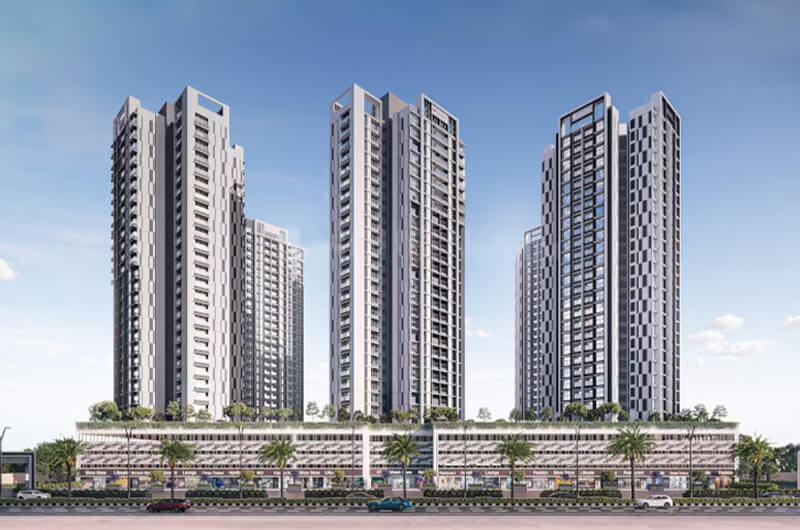
Redevelopment in Navi Mumbai: what members should understand
Navi Mumbai's earliest buildings are now old enough that redevelopment is a live conversation in a growing number of societies. For members it is the largest financial decision most will make after buying, and it is usually made with far less diligence than the original purchase. The mechanics are knowable, and knowing them changes the terms you end up with.
What redevelopment actually is
A society agrees that its existing building will be demolished and rebuilt, generally by a developer who funds the construction in exchange for the right to sell additional units created by the extra development potential on the plot.
Members typically receive a larger flat in the new building, a corpus payment, and rent for alternate accommodation during construction. The developer's return comes from the units they sell.
That structure is why the available development potential on the plot matters so much. It determines how much there is to share, and therefore what terms a society can realistically negotiate.
Self-redevelopment is the alternative, where the society finances and manages the project itself, retaining the value a developer would otherwise take. It is more demanding and increasingly common where societies have the capacity for it.
- Developer funds construction, sells the additional units created
- Members receive a larger flat, corpus and rent during construction
- Available development potential determines what can be shared
- Self-redevelopment retains that value but requires capacity
The prerequisites most societies discover late
Deemed conveyance is the first. Where the society has never obtained conveyance of the land from the original developer, it does not hold the land it proposes to redevelop, and this must be resolved before anything else. Societies routinely discover this only when redevelopment is proposed.
In Navi Mumbai the CIDCO position is the second. Where the land is CIDCO leasehold, CIDCO's permissions and dues sit alongside the planning approvals, and this adds both time and cost. Our guide to which authority governs your flat covers how the bodies divide.
Member consent is the third. A defined majority is required under the applicable co-operative provisions, and the threshold and procedure are set by state rules that are revised from time to time, so confirm the current position rather than relying on what a developer tells the society.
A society that resolves these before inviting proposals negotiates from a much stronger position than one that discovers them midway.
The terms that decide whether it was worth it
Additional carpet area is the headline and the one members focus on, but it should be specified as RERA carpet area rather than any other measure. Our guide to carpet area versus built-up area covers why that distinction matters most precisely here.
The corpus payment, when it is paid and whether it is secured, is the second. A corpus promised on completion from a developer who runs into difficulty is worth considerably less than one secured up front.
Rent for alternate accommodation is the third, and the critical terms are the amount, the escalation over a long project, and what happens if construction overruns. Projects run late; agreements that stop paying rent at a fixed date leave members carrying the cost of the delay.
Security for performance is the fourth. A bank guarantee or equivalent gives the society something to enforce against, and its absence is the single largest structural weakness in a weak agreement.
- Additional area specified as RERA carpet area
- Corpus amount, timing and whether it is secured
- Rent amount, escalation, and what happens on overrun
- A bank guarantee or equivalent performance security
Where redevelopment goes wrong
Delay is the most common failure and the most damaging. Members are out of their homes, dependent on rent payments that may stop, and holding an asset they cannot occupy or easily sell.
Developer financial difficulty is the usual cause. A developer whose returns depend on selling the additional units is exposed to the market, and a slow market becomes the society's problem.
Specification erosion is the second failure. What was promised in the presentation and what appears in the agreement often differ, and what is built can differ again. Anything not written into the agreement with defined materials is not a commitment.
Internal division is the third and the most avoidable. Societies where a minority feel steamrolled produce litigation that delays everyone, and a slower process with genuine consensus is usually faster in the end.
How to assess a developer proposal
Look at completed redevelopment projects specifically, not the developer's general portfolio. Redevelopment is a different discipline from greenfield building, and a strong record in one does not imply the other.
Visit those completed societies and speak to members. They will tell you about delay, specification and disputes in a way no document will, and they have no reason to shade the truth.
Check the financial position. A developer relying entirely on future sales to fund construction is a different risk from one with balance-sheet capacity, and the difference shows up precisely when the market slows.
Confirm MahaRERA registration for the project, which brings disclosure and the enforcement route our note on builder delay rights describes.
Self-redevelopment as the alternative
Where a society can access financing and has members with the capacity to manage a project, self-redevelopment retains the developer's margin for the members.
The requirements are real: a competent project management team, a co-operative bank or lender willing to fund, sustained member cohesion over several years, and the appetite to carry construction risk collectively.
It is not suitable for every society, and a poorly managed self-redevelopment is worse than a well-negotiated developer arrangement. The honest test is whether the society has genuinely capable members willing to commit years to it, rather than enthusiasm at a general body meeting.
Where the capacity exists, the financial difference is substantial enough to justify serious investigation before accepting a developer proposal.
- Retains the developer margin for members
- Requires financing, project management and sustained cohesion
- Worse than a good developer deal if managed poorly
What individual members should do
Engage early rather than at the vote. The terms are shaped long before members are asked to approve them, and a member who first reads the agreement at the general body meeting has no practical influence.
Insist the society appoints its own project consultant and lawyer, paid by the society and acting for it. A developer-introduced professional is not the society's adviser regardless of who nominally pays.
Read the agreement yourself, particularly the rent, corpus, area and security clauses. Our note on the agreement clauses worth checking covers the same discipline applied to individual purchases.
And plan your own finances for a longer displacement than promised. Projects overrun, and members who budgeted for the stated timeline are the ones under pressure when it slips.