Taloja Phase 1 vs Phase 2: Which Should You Pick?
Taloja gets treated as one market, which is why buyers keep getting surprised by it. Phase 1 and Phase 2 developed at different times, sit at different distances from the metro, and behave differently on resale. The choice between them is not a technicality — it is the main decision you make in this node, and it is usually made by accident.
What is the actual difference between Taloja Phase 1 and Phase 2?
Phase 1 is the older, more built-up half of the node, where earlier development concentrated and where everyday services have had longer to establish themselves. Phase 2, around the Taloja Panchanand belt, is the newer half where most current supply is being added.
The practical consequence is maturity. In Phase 1 you get a neighbourhood that already functions — shops, transport, established societies. In Phase 2 you get newer buildings, more choice, and surroundings that are still filling in around you.
Neither is objectively better. They are at different points on the same curve, and the discount you get in Phase 2 is compensation for standing further back on it.
Which phase has better metro access?
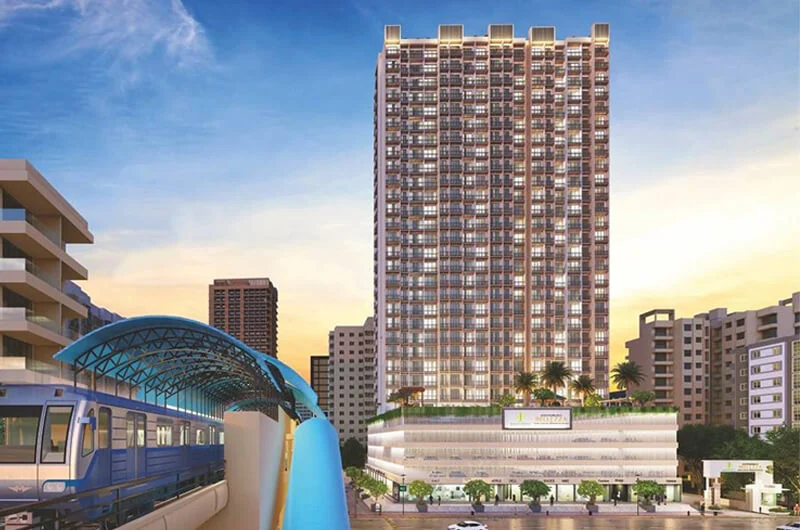
Phase 2 generally, because the Pendhar end of Metro Line 1 sits on that side and several Phase 2 projects are marketed explicitly on station proximity.
Geetanjali Bellezza in Sector 23 of Phase II and Dedrani One Valencia both use Pendhar station as their reference point, at Rs. 45 L - 75 L and Rs. 42 L - 72 L respectively. Yash Bhiva Tower in Sector 17 of Phase 2 sits in the same belt at Rs. 40 L - 63 L.
Metro access here mainly improves movement within Navi Mumbai rather than into Mumbai, so weigh it against your real travel pattern. The Metro Line 1 price impact guide covers what the line does and does not change.
Which phase is cheaper, and by how much?
The two overlap heavily rather than sitting in separate price brackets, which surprises buyers expecting a clean discount for the newer half. Both phases currently carry inventory from the mid-thirties to the mid-seventies in lakh terms.
What differs more than headline price is what the money buys. Phase 1 stock like Millenial Towers at Rs. 41 L - 68 L trades on a settled location; Phase 2 stock at a similar number trades on newer construction and station access.
Because the ranges overlap, comparing on quoted rate is close to useless here. Compare all-in cost per square foot of carpet instead — the carpet area guide explains why the quoted figure is not comparable across projects.
Which phase should you buy for end use?
Phase 1, in most cases, if you are moving in soon and have a family. A neighbourhood that already works is worth more day to day than a newer building in a place still under construction around you.
- Choose Phase 1 if you need existing shops, schools and transport from day one.
- Choose Phase 2 if metro proximity genuinely changes your commute several times a week.
- Choose Phase 2 if you want newer construction and are comfortable with a developing environment.
- Choose Phase 1 if resale within a few years is a realistic possibility — the market there is better established.
- Either way, browse the full Taloja shelf rather than only what one agent shows you.
Which phase should an investor prefer?
Phase 2 has the stronger appreciation case because it starts from a less mature base with a transit anchor attached, while Phase 1 has the better rental and resale liquidity today.
That maps onto a familiar trade-off: percentage upside versus the ability to exit. If you can hold through the node building out, Phase 2 is the more interesting bet. If you want rental income and a market that can absorb your sale, Phase 1 is the safer one.
Read the Taloja investment guide for the node-level case, and the Taloja appreciation guide for how the market has actually moved rather than how it is pitched.
What should you check before committing to either phase?
The same four things, done properly: the walk to daily services, the real commute, the project's registration, and the all-in cost.
- Walk from the project to the nearest grocery, chemist and school — the distance you would actually cover on a weekday.
- Drive or ride your real commute at the hour you would travel, not at noon on a Sunday.
- Confirm the MahaRERA number applies to your specific tower — see the RERA guide.
- Ask about water supply and civic services specifically; in developing pockets these vary more than buyers expect.
- Build the all-in number using the hidden costs guide before comparing anything.
- If you are weighing Taloja against the adjacent belt, read the Taloja versus Upper Kharghar comparison.